Live in Production
Zero to 10K+ Users: New Shopping Platform for Parents
Zero to 10K+ Users: New Shopping Platform for Parents
End-to-end design of a new community-driven shopping platform, helping parents make confident purchases through product recommendations.
End-to-end design of a new community-driven shopping platform, helping parents make confident purchases through product recommendations.
INDUSTRY
e-Commerce
DURATION
6 Months
YEAR
2024
MY ROLE
Product Designer
THE TEAM
Product Manager,
4 Software Engineers
DELIVERABLES
MVP Definition
User Research & Testing
Competitive Analysis
Information Architecture & User Flows
Wireframes (early exploration & validation)
Interaction Design
High-Fidelity Design & Prototypes
Design System & Component Library
Final Specs & Design QA

Impact Snapshot
🚀 Launched a brand-new product in 6 months
🚀 Launched a brand-new product in 6 months
👥 10K+ users joined in the first 3 months
👥 10K+ users joined in the first 3 months
🧠 Reduced decision fatigue and supported confident purchase decisions through recommendations from like-minded parents
🧠 Reduced decision fatigue and supported confident purchase decisions through recommendations from like-minded parents
⚙️ Enabled faster iteration and product consistency through a new design system
⚙️ Enabled faster iteration and product consistency through a new design system
The Context
I worked at The Bump, a well-established B2C American digital brand supporting parents and parents-to-be throughout their journey.
I worked at The Bump, a well-established B2C American digital brand supporting parents and parents-to-be throughout their journey.
On this project, I helped bringing The Bump Shop to life, a brand new e-comm experience to help parents reduce decision fatigue by knowing what to purchase in every stage of their parenting journey, based on trusted recommendations from parents like them and experts.
On this project, I helped bringing The Bump Shop to life, a brand new e-comm experience to help parents reduce decision fatigue by knowing what to purchase in every stage of their parenting journey, based on trusted recommendations from parents like them and experts.
I worked with a product manager and four software engineers, and collaborated with many other people at the company to bring this product to life. I was responsible for the end-to-end design process, from problem framing through delivery.
I worked with a product manager and four software engineers, and collaborated with many other people at the company to bring this product to life. I was responsible for the end-to-end design process, from problem framing through delivery.
The Problem
Preparing for a new baby is exciting—but also overwhelming. New parents are faced with endless product choices, from strollers to bottles, often not knowing what’s essential.
Preparing for a new baby is exciting—but also overwhelming. New parents are faced with endless product choices, from strollers to bottles, often not knowing what’s essential.
While platforms like Amazon offer variety, users often find it difficult to trust product reviews, as in many cases they are promotional or too generic. As a result, parents are left to search across blogs, social media, forums, and more to discern whether a product is truly worth it, often feeling overwhelmed and paralyzed to make the “right” choice.
While platforms like Amazon offer variety, users often find it difficult to trust product reviews, as in many cases they are promotional or too generic. As a result, parents are left to search across blogs, social media, forums, and more to discern whether a product is truly worth it, often feeling overwhelmed and paralyzed to make the “right” choice.
We saw an opportunity to build a product that combines baby e-commerce with real recommendations from parents, friends, and experts to guide families through each stage of their parenting journey.
We saw an opportunity to build a product that combines baby e-commerce with real recommendations from parents, friends, and experts to guide families through each stage of their parenting journey.
The Challenge & Goals
The goal for the project was excited yet ambitious: launch a fully functional and tested e-commerce experience in only 6 month to validate product market-fit.
The goal for the project was excited yet ambitious: launch a fully functional and tested e-commerce experience in only 6 month to validate product market-fit.
Our high-level goals were to:
Our high-level goals were to:
Release The Bump Shop beta to the public by December 2024
Release The Bump Shop beta to the public by December 2024
Allow users to build a network of like-minded parents and have a sense of community
Allow users to build a network of like-minded parents and have a sense of community
Help parents make confident purchase decisions based on recs from the community
Help parents make confident purchase decisions based on recs from the community
the solution
After 6 months of hard work and focus, we launched The Bump Shop in December 2024.
After 6 months of hard work and focus, we launched The Bump Shop in December 2024.
A community-powered shopping experience where parents can discover, recommend, and share baby products based on real-life experience, while supporting each other.
A community-powered shopping experience where parents can discover, recommend, and share baby products based on real-life experience, while supporting each other.
Stage-Based Discovery for Guided Decisions
Home experience was designed to make product discovery more relevant for parents by organizing products by stage.
Home experience was designed to make product discovery more relevant for parents by organizing products by stage.
🔍 Insight:
Parents framed their needs around parenting stages not product categories, sharing that in many cases they didn’t even know where to start looking.
Parents framed their needs around parenting stages not product categories, sharing that in many cases they didn’t even know where to start looking.
⚖️ Core trade-off:
The initial proposal was a personalized experience, showing products for the user’s current stage, a “plan ahead” section, and community highlights. However, due to technical constraints, we decided to launch with a full list of stages, allowing us to ship faster while still being reliable for users.
The initial proposal was a personalized experience, showing products for the user’s current stage, a “plan ahead” section, and community highlights. However, due to technical constraints, we decided to launch with a full list of stages, allowing us to ship faster while still being reliable for users.
🎯 Key design decisions:
Products organized by stage instead of traditional categories to match user’s mental model and speed up decision-making.
Products organized by stage instead of traditional categories to match user’s mental model and speed up decision-making.
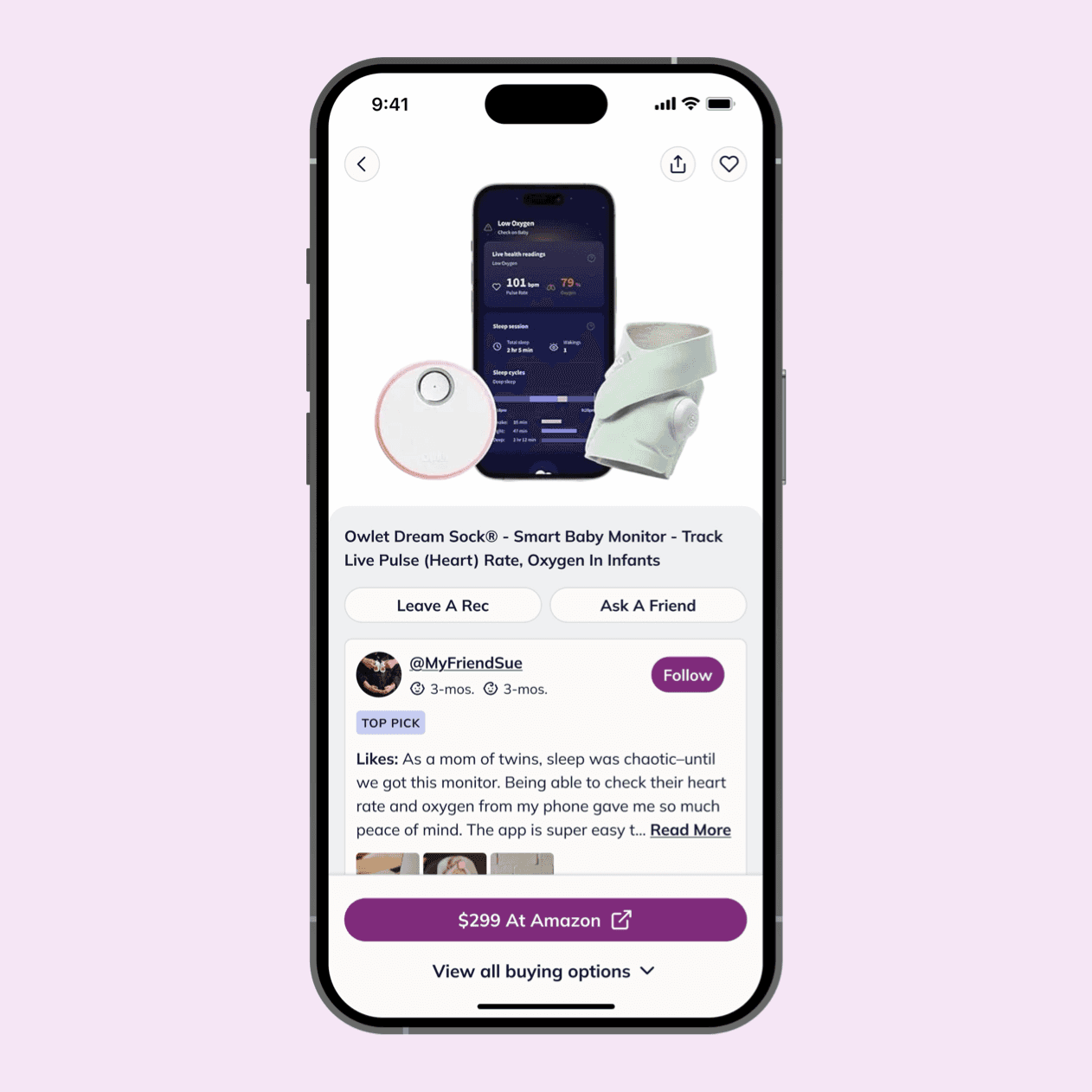
Product pages for confident decisions
Product pages were designed to help users move from consideration to decision by combining recs from real-parents, clear product info, and call-to-actions.
Product pages were designed to help users move from consideration to decision by combining recs from real-parents, clear product info, and call-to-actions.
🔍 Insight:
Users needed reassurance before purchasing products for their babies, especially from parents like them. Displaying product recommendations helped reduce decision anxiety and increase confidence.
Users needed reassurance before purchasing products for their babies, especially from parents like them. Displaying product recommendations helped reduce decision anxiety and increase confidence.
⚖️ Core trade-off:
Trade-off 1: Product recs were prioritized over detailed specs and comparison features to better support users’ reassurance needs.
Trade-off 1: Product recs were prioritized over detailed specs and comparison features to better support users’ reassurance needs.
Trade-off 2: The decision was to keep the current affiliate revenue model and avoid a full checkout experience to reduce complexity.
Trade-off 2: The decision was to keep the current affiliate revenue model and avoid a full checkout experience to reduce complexity.
🎯 Key design decisions:
Recs placed front and center to build confidence through social proof
Recs placed front and center to build confidence through social proof
Expert-backed tips to add an extra layer of confidence
Expert-backed tips to add an extra layer of confidence
“Leave a rec”, “Ask a friend”, and “Follow” to build reassurance through social interactions
“Leave a rec”, “Ask a friend”, and “Follow” to build reassurance through social interactions
External retailer redirection to support faster decisions
External retailer redirection to support faster decisions
Product recs with structure & honesty
Recommendations are key to nurture the snowball effect needed to build user trust and enrich the product experience. The flow was designed to help users provide their honest opinions about products in a guided and structured way.
Recommendations are key to nurture the snowball effect needed to build user trust and enrich the product experience. The flow was designed to help users provide their honest opinions about products in a guided and structured way.
🔍 Insight:
User testing showed that users appreciated the step-by-step guided approach to providing feedback. They valued the helpfulness of prompt instructions and the presence of a separate field for “dislikes,” which they felt made recommendations more trustworthy. Users also appreciated “skippable” steps and the freedom to decide.
User testing showed that users appreciated the step-by-step guided approach to providing feedback. They valued the helpfulness of prompt instructions and the presence of a separate field for “dislikes,” which they felt made recommendations more trustworthy. Users also appreciated “skippable” steps and the freedom to decide.
⚖️ Core trade-off:
Stage-based product prompts were deprioritized due to technical constraints, and only direct product search was implemented instead.
Stage-based product prompts were deprioritized due to technical constraints, and only direct product search was implemented instead.
🎯 Key design decisions:
Step-by-step recommendation flow over a single form to reduce fatigue
Step-by-step recommendation flow over a single form to reduce fatigue
Uploading photos, top picks, and pros and cons steps to ensure relevance and trustworthiness
Uploading photos, top picks, and pros and cons steps to ensure relevance and trustworthiness
Final recommendation preview over direct publication to give users control and the ability to edit beforehand
Final recommendation preview over direct publication to give users control and the ability to edit beforehand
building a trusted Community
Designed to support the community aspect of the product, allowing users to expand their network of like-minded parents for confident purchase decisions.
Designed to support the community aspect of the product, allowing users to expand their network of like-minded parents for confident purchase decisions.
🔍 Insight:
Users expressed that they trusted like-minded parents who shared similar interests, parenting stage, and family context when it came to baby product recommendations.
Users expressed that they trusted like-minded parents who shared similar interests, parenting stage, and family context when it came to baby product recommendations.
⚖️ Core trade-off:
We deprioritized interest- and stage-based suggestions in favor of manual network growth due to technical constraints.
We deprioritized interest- and stage-based suggestions in favor of manual network growth due to technical constraints.
🎯 Key design decisions:
Interest-based feed over popularity to support trust in like-minded users
Interest-based feed over popularity to support trust in like-minded users
Invite-a-friend feature to grow the user’s network with trusted relationships and support long-term business metrics
Invite-a-friend feature to grow the user’s network with trusted relationships and support long-term business metrics
Parent-first content over leading with product recs to build trust before purchase
Parent-first content over leading with product recs to build trust before purchase
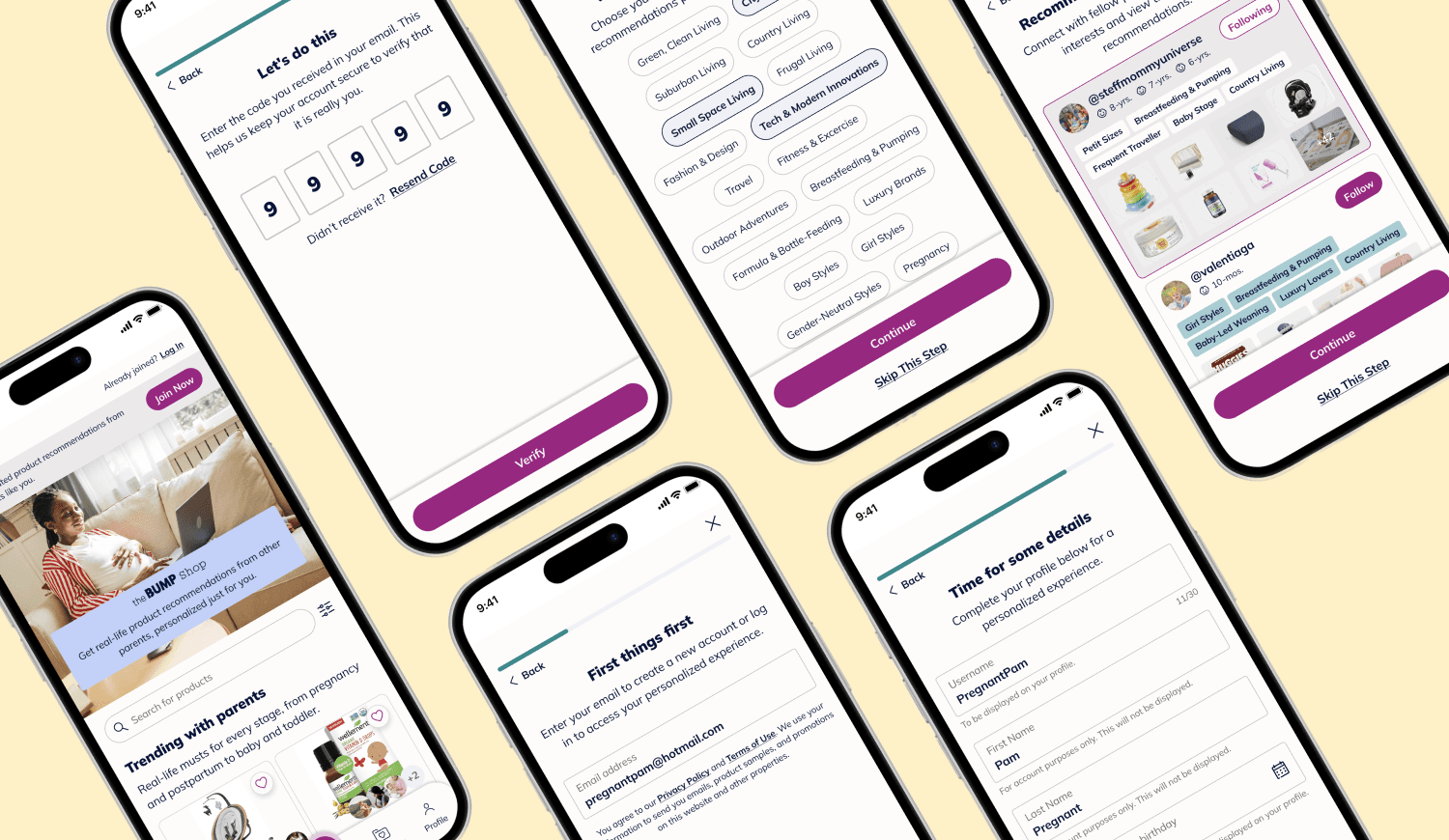
Onboarding for Personalization & Trust
The onboarding was designed to make users feel welcomed, and respect privacy concerns.
The onboarding was designed to make users feel welcomed, and respect privacy concerns.
🔍 Insight:
Users felt overwhelmed by long onboarding flows and expressed concerns about data privacy and anonymity during research.
Users felt overwhelmed by long onboarding flows and expressed concerns about data privacy and anonymity during research.
⚖️ Core trade-off:
Execs wanted to add “recommend a product” steps to increase the number of recommendations on the platform. However, to avoid overwhelming users, faster time-to-value was prioritized.
Execs wanted to add “recommend a product” steps to increase the number of recommendations on the platform. However, to avoid overwhelming users, faster time-to-value was prioritized.
🎯 Key design decisions:
Progressive onboarding over upfront profile creation to reduce fatigue
Progressive onboarding over upfront profile creation to reduce fatigue
OTP verification over password creation to lower friction
OTP verification over password creation to lower friction
Privacy-first profile with usernames as the only public identifier
Privacy-first profile with usernames as the only public identifier
Interests + following to enable personalized content
Interests + following to enable personalized content
Save for Later for Decision Support
Favorites experience was designed to help users keep track of their interests and build a list to explore or purchase later, without the pressure to decide right away.
Favorites experience was designed to help users keep track of their interests and build a list to explore or purchase later, without the pressure to decide right away.
🔍 Insight:
Shopping for a baby requires deep research and consideration rather than impulsive purchases. Users often didn’t have the time or mental space to decide in the moment, which is why they valued the ability to save products and return to them later.
Shopping for a baby requires deep research and consideration rather than impulsive purchases. Users often didn’t have the time or mental space to decide in the moment, which is why they valued the ability to save products and return to them later.
⚖️ Core trade-off:
Execs and product had high ambitions for this feature, knowing it would evolve over time. We decided to launch a bare-minimum experience for the beta version, prioritizing speed and leaving room for post-launch iteration.
Execs and product had high ambitions for this feature, knowing it would evolve over time. We decided to launch a bare-minimum experience for the beta version, prioritizing speed and leaving room for post-launch iteration.
🎯 Key design decisions:
Stick to familiar placement, labels and iconography to reduce relearning
Stick to familiar placement, labels and iconography to reduce relearning
Simple grid layout for consistency and support future iteration plans
Simple grid layout for consistency and support future iteration plans
Quick access to product details to resume decision-making with ease
Quick access to product details to resume decision-making with ease


public profiles for trust & relevance
Public profiles help users understand who is behind a recommendation, offering enough context to judge relevance and build trust before exploring a product.
Public profiles help users understand who is behind a recommendation, offering enough context to judge relevance and build trust before exploring a product.
🔍 Insight:
Parents trusted recommendations more when they could relate to the person sharing them through signals like parenting stage and interests. They didn’t need full personal details—just enough context to judge relevance.
Parents trusted recommendations more when they could relate to the person sharing them through signals like parenting stage and interests. They didn’t need full personal details—just enough context to judge relevance.
⚖️ Core trade-off:
Messaging was left out due to time constraints, and public profile information was intentionally limited to prioritize safety and users’ peace of mind.
Messaging was left out due to time constraints, and public profile information was intentionally limited to prioritize safety and users’ peace of mind.
🎯 Key design decisions:
Stage and interests tags to communicate relevance at a glance
Stage and interests tags to communicate relevance at a glance
Person-anchored product cards over standard ones to build trust before buying intent
Person-anchored product cards over standard ones to build trust before buying intent
Private Profiles for Safety & Control
Private profiles were designed to help users share and contribute at their own pace, while maintaining privacy and control.
Private profiles were designed to help users share and contribute at their own pace, while maintaining privacy and control.
🔍 Insight:
Parents were willing to share personal context to make recommendations more relevant and were happy to help others. However, they were cautious about exposing personal information publicly—especially early on—and appreciated the flexibility to complete their profile over time.
Parents were willing to share personal context to make recommendations more relevant and were happy to help others. However, they were cautious about exposing personal information publicly—especially early on—and appreciated the flexibility to complete their profile over time.
⚖️ Core trade-off:
We prioritized privacy and user safety over network growth, in exchange for higher trust and participation.
We prioritized privacy and user safety over network growth, in exchange for higher trust and participation.
🎯 Key design decisions:
Optional profile information over mandatory fields to support flexibility and gradual engagement
Optional profile information over mandatory fields to support flexibility and gradual engagement
Username-based identity over real names to support anonymity
Username-based identity over real names to support anonymity
Instagram-like profile layout to reinforce a familiar social experience
Instagram-like profile layout to reinforce a familiar social experience

Lessons learned
User trust was a key growth driver and came from recs by like-minded parents, enabling adoption and engagement without relying on more content or features.
User trust was a key growth driver and came from recs by like-minded parents, enabling adoption and engagement without relying on more content or features.
Structuring discovery around users’ mental models (stages and like-minded parents) reduced decision fatigue, and increasing the likelihood of conversion.
Structuring discovery around users’ mental models (stages and like-minded parents) reduced decision fatigue, and increasing the likelihood of conversion.
Clear trade-offs and a focused MVP made it possible to ship within constraints, prioritizing time-to-value while laying a scalable foundation for future iteration.
Clear trade-offs and a focused MVP made it possible to ship within constraints, prioritizing time-to-value while laying a scalable foundation for future iteration.
Other Case Studies



Product pages for confident decisions
Product pages were designed to help users move from consideration to decision by combining recs from real-parents, clear product info, and call-to-actions.
🔍 Insight:
Users needed reassurance before purchasing products for their babies, especially from parents like them. Displaying product recommendations helped reduce decision anxiety and increase confidence.
⚖️ Core trade-off:
Trade-off 1: Product recs were prioritized over detailed specs and comparison features to better support users’ reassurance needs.
Trade-off 2: The decision was to keep the current affiliate revenue model and avoid a full checkout experience to reduce complexity.
🎯 Key design decisions:
Recs placed front and center to build confidence through social proof
Expert-backed tips to add an extra layer of confidence
“Leave a rec”, “Ask a friend”, and “Follow” to build reassurance through social interactions
External retailer redirection to support faster decisions
building a trusted Community
Designed to support the community aspect of the product, allowing users to expand their network of like-minded parents for confident purchase decisions.
🔍 Insight:
Users expressed that they trusted like-minded parents who shared similar interests, parenting stage, and family context when it came to baby product recommendations.
⚖️ Core trade-off:
We deprioritized interest- and stage-based suggestions in favor of manual network growth due to technical constraints.
🎯 Key design decisions:
Interest-based feed over popularity to support trust in like-minded users
Invite-a-friend feature to grow the user’s network with trusted relationships and support long-term business metrics
Parent-first content over leading with product recs to build trust before purchase
On repeat
Navigation
Contact
Available for work
Case Studies



2026 Rocío Álvarez. All rights reserved.
On repeat
Navigation
Contact
Available for work
Case Studies
2026 Rocío Álvarez. All rights reserved.
On repeat
Navigation
Contact
Available for work
Case Studies
2026 Rocío Álvarez. All rights reserved.