Live Prototype
Helping restaurant app users
book deals with confidence
Helping restaurant app users
book deals with confidence
NeoTaste users leave the app to cross-check on Google Maps before booking. I designed a social discovery layer — friend proof, community proof, crowd proof — that gives them the confidence to stay and book.
NeoTaste users leave the app to cross-check on Google Maps before booking. I designed a social discovery layer — friend proof, community proof, crowd proof — that gives them the confidence to stay and book.
🕚 ~ 4 min read



ABOUT
NeoTaste is a restaurant discovery and deals app operating in Germany, the UK, the Netherlands, and Austria.
PROBLEM
The app had a trust gap: users were leaving to cross-check on Google Maps before committing to a booking.
DESIGN CHALLENGE
Design a lightweight social discovery layer that surfaced trust signals inside the existing experience — without adding complexity or building a social network.
TEAM
x1 Product Designer (Me)
x1 AI-assisted development (Claude Code)
x19 Peer design feedback
MY ROLE
Product & design strategy
UX & interaction design
Usability testing
Prototype development
TIMELINE
2.5 weeks · May 2026
NORTH STAR METRIC
Deal bookings
SECONDARY METRIC
App growth
CONTEXT
Discovery is functional, not social
NeoTaste users find great deals nearby. But they're making decisions in isolation. There's almost no sense of what other people think, where friends are going, or what's genuinely worth trying.
NeoTaste wants to explore how social signals (friends, community activity, trust cues) could make restaurant discovery feel more personal, more trustworthy, and more engaging.
AI Moment
I pressure-tested the initial north star with Claude. The exercise revealed retention was a lagging indicator — bookings per user per month was the right lever.
challenge
How might we make users choose a place because they want to go there, not just because it's discounted?
CONSTRAINTS
The non-negotiable boundaries
No video feed
Feature ruled out as it was already tested without performance
Cold start friendly
Must work with zero friends, the cold start is not an edge case
Must feel native
Design for Neotaste today, using existing component, not a redesign
iOS-frist (~70% of users)
The design should be mobile-first with iOS patterns in mind
Keep it lightweight
Keep it effort appropriate avoiding complex friend systems
No heavy moderation
Avoid complex backend systems to keep the solution well scoped
AI Moment
I roleplayed each flow as a zero-friends user with Claude to pressure-test this constraint. It moved cold start from a secondary consideration to the starting point of the design.
AI & PROCESS
How AI Shaped the Work
I set up Claude with the product brief, social proof psychology research, and a custom feedback framework before any design work began.
Moments where AI changed the work:
North star reframe
I pressure-tested the initial north star to reveal that retention was a lagging indicator. It shifted to bookings per user per month.
Cold start first
I roleplayed each flow as a zero-friends user to surface that cold start wasn't an edge case — it was the default first session. Community proof was designed before friend proof, not after.
Third pin cut
I ran a cold start lens review that flagged three pin types were too many to read at a glance. Third pin type cut.
Prototype build
I used Claude Code to build the prototype directly against the NeoTaste design system extracted from Figma via MCP.
PROBLEMS & OPPORTUNITIES
Assessing the current app experience
Discovery
Filters
Restaurant details
Deal booking
Redeem & Review
Home feed
Reward

Default map view
Problem
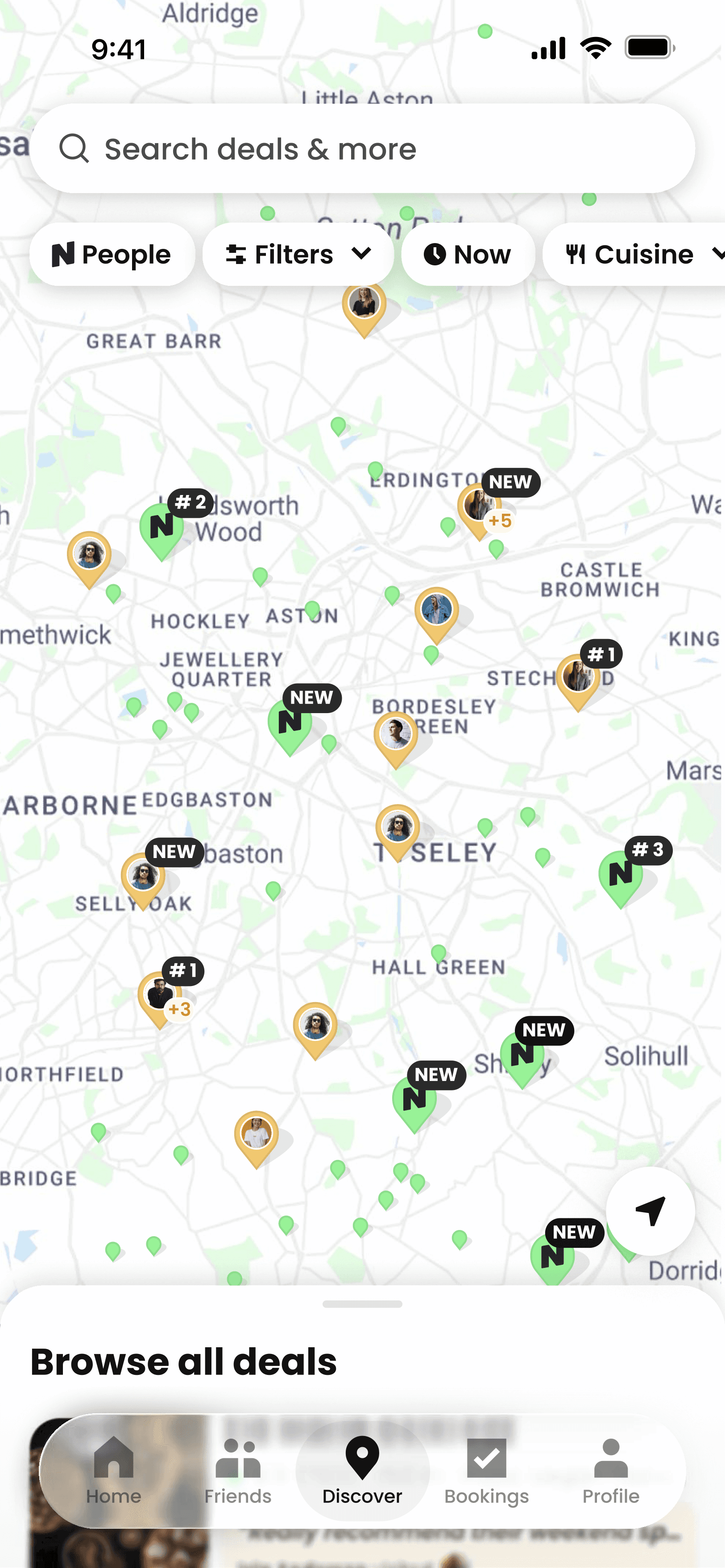
The map shows every restaurant the same way — identical green pins, no hierarchy, no signal. Users can't tell what's worth tapping, so they either tap everything or nothing.
Opportunity
Discover is where most users spend their time and make their booking decisions. It's the highest-leverage surface to introduce social signals.
DECISION TIME
Scoping the social layer to 3 surfaces
Discovery
The highest-traffic surface. Social signals here directly influence what gets booked.
Restaurant details
Where hesitation lives. The right signal removes the need to verify elsewhere.
Deal booking
The highest-trust moment in the flow. The right prompt turns one booking into the next.
AI Moment
I used Claude to pressure-test the audit — ranking each surface by impact on bookings and cross-referencing against the social proof hierarchy. That ranking is what scoped the social layer to three surfaces.
CHALLENGE 01
Discovering restaurants through people
Final design
Cold start
Explored & tested
Default map

Default map (zoomed in pin)

Pin selected (zoomed in pin)

List view

Friends filter

NeoTasters filter

Friends filter applied
Design decisions
Yellow pin with avatar for friends, green full pin for new spots and ranked picks, green tiny dot for everything else
Tapping any pin surfaces a card with a colour-coded quote snippet with a social proof and deal CTAs to book without leaving the map
People filter narrows the map to restaurants where friends or trusted NeoTasters have been
Logic
Two pin types give users an instant read — and low-priority pins shrink to keep high-intent signals front and centre
Quick-booking card removes a step between interest and booking
"People" filter hands users control over
Final design
Cold start
Explored & tested

Default map

Default map (zoomed in pin)

Pin selected (zoomed in pin)

List view

Friends filter

NeoTasters filter

NeoTasters filter applied
Design decisions
Without friends, NeoTasters fill the map
Opening the People filter defaults to the NeoTasters tab when no friends are connected
Friends tab shows an empty state with a prompt to invite friends
Logic
The app works from day one — community proof covers what friend proof can't yet deliver
Defaulting to NeoTasters avoids surfacing a failure state as the first impression
The empty Friends tab earns its place: it's the right moment to explain the value of inviting friends, when the user already understands what they'd get
Final design
Cold start
Explored & tested

Default map

Default map (zoomed in pin)

Pin selected (zoomed in pin)

List view

Friends filter

Friends filter applied
Design decisions
Social Cues Hierarchy displayed one signal at a time per tooltip, in priority order: friend proof → novelty & ranked → crowd proof
Floating card with restaurant summary and social tags
Social tags on the card were later replaced by a quote snippet to avoid repetition and reduce clutter
Logic
All 7 testers completed the booking task — but couldn't explain why they picked one restaurant over another
Social cues were ignored entirely; testers chose based on visual attention, gravitating toward yellow-highlighted ranked restaurants
Information overload was flagged — too much on the map
Findings that informed the final design: yellow for friend pins, and a two-pin system to reduce clutter from the start
AI Moment
I ran a cold start lens review with Claude that flagged three pin types were too many to scan at a glance. Third pin cut before it reached testing.
I used Claude to synthesise round 1 findings into concept problems vs. execution problems. That distinction shaped what round 2 fixed — and what it left alone.
DECISION TIME
Two pin types cut the noise. Friend visits surface in yellow — everything else in green. Tap any pin and a quick-booking card closes the gap between interest and booking. Working, with or without friends.
CHALLENGE 02
Restaurant pages optimized for booking
Final design
Cold start

Above the fold

"Overview" tab
"Ratings & Reviews" > Friends tab

"Ratings & Reviews" > NeoTasters tab

"About" tab
Design decisions
Social proof quote above the fold and "Location" CTA moved last
Now primary and secondary deal, "Info" moved below cards
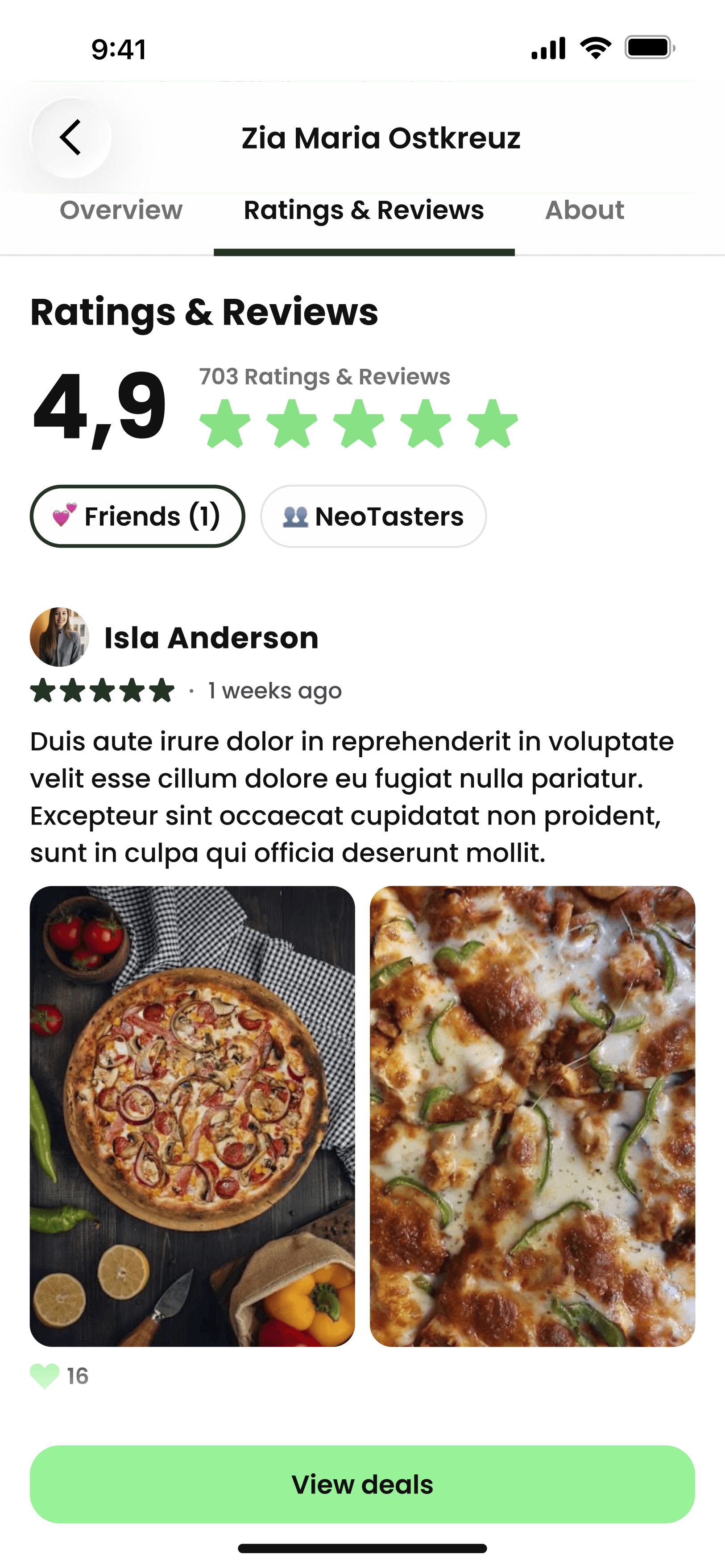
Rating count above stars — volume first, quality second
Sticky "View deals" always reachable
"Open on maps" CTA changed for "Get directions" and tertiary type
Logic
The quote lands confidence before users scroll and moving "Location" last removes the exit before the decision
Deal hierarchy cuts hesitation
Rating count matches how users decide and "Friends" surfaces the most trusted signal first — community proof works as support
The maps CTA renamed to state intent vs an obvious app exit
Final design
Cold start

Above the fold
"Overview" tab

"Ratings & Reviews" > NeoTasters tab

"Ratings & Reviews" > Friends tab

"About" tab
Design decisions
Quote appears in light green — to follow the visual language of NeoTaster pins on the map
"15 visited this week" replaces friend input above the fold
Ratings & Reviews defaults to NeoTasters tab; Friends tab stays visible with an invite prompt
Logic
Light green creates continuity with the map — users already associate it with community proof
Recency beats aggregates: "visited this week" signals the place is active now, not just historically rated
Defaulting to NeoTasters avoids a zero-content tab as the first impression — keeping Friends visible turns the empty state into an invite prompt, driving both trust and growth
AI Moment
A copy audit with Claude flagged "Open on maps" as exit-framing. Renaming it to "Get directions" kept the intent without signalling a way out.
DECISION TIME
Every change on this screen pointed to one direction: remove the friction between landing and booking. Social proof above the fold, clear deal hierarchy, trusted reviews first — and no CTA that makes leaving feel like the next step.
CHALLENGE 03
Booking deals that bring people in

Deal options

Deal selection

Deal booking confirmation

Deal booking confirmation (on scroll)
Design decisions
Confirmation screen consolidates everything needed to show up: native map, "Get directions", and "Call" in one place
"Share with friend" as primary CTA, "Go to bookings" as secondary
Logic
Peak emotion is the best moment to pass the signal forward — one share turns one booking into the next
Everything to show up and share — no friction, no detour to bookings
DECISION TIME
The booking confirmation was the highest-emotion moment in the flow — and the only one with no growth mechanic. "Share with friend" as the primary CTA captures that moment to turn one booking into the next.
next steps
Close content loop to reduce user leaking

Notification prompt to review

Default review sheet

Filling review sheet

Filling review sheet

Posted review confirmation
Decision decisions
Push notification prompts the review after the visit, not at redemption
Review sheet captures occasion tags, star rating, free text, and photos
Logic
Separating the review from redemption gets more honest, thoughtful input — the right moment is after the meal, not during it
Occasion tags lower the effort to contribute without sacrificing signal quality
Every review posted becomes community proof for the next user — closing the content loop NeoTaste currently relies on Google Maps to fill
FINAL REFLECTIONs
Connecting the dots
Users left because NeoTaste only showed deals — no signal that a place was actually worth going to. The social layer adds that signal: friend activity, real redemption data, user photos. The decision now has enough context to happen without leaving.
NeoTaste wants to explore how social signals (friends, community activity, trust cues) could make restaurant discovery feel more personal, more trustworthy, and more engaging.
Between 2 sufaces
Sits between discovery and restaurant detail. No separate social screen.
Works at 0 friends
Cold start friendly. When no friends, the community fills the gap from day one.
Meets users where they are
Strategically placed. Discover is where most of NeoTaste's traffic goes.
Social & Business centric
Unlocks bookings and app growth. If the social layer works, the business too.
Other Case Studies



On repeat
Navigation
Contact
Available for work
Case Studies



2026 Rocío Álvarez. All rights reserved.
On repeat
Navigation
Contact
Available for work
Case Studies
2026 Rocío Álvarez. All rights reserved.
Other Case Studies
Connect to Content
Add layers or components to swipe between.